


The short answer
For most home gyms, the best flooring is stacked rubber, a softer engineered underlay bonded to a tough wear surface. ECORE Rally is the one we install most. If the gym is part of the house, a finished basement, a bonus room, or a space that doubles as an office, the best floor is often ECORE Ebb & Flow, and it doesn't look like gym flooring at all. If someone lives or sleeps below the gym, add ECORE Shockpad underneath either one, or go with DBTile.
That's the answer we give in our Newton, MA showroom almost every week. The rest of this post explains why, and how it changes depending on the room you're working with.
The floor that surprises people: Ebb & Flow
When clients see Ebb & Flow in the showroom for the first time, the reaction is almost always the same: that's gym flooring? It has a woven look that reads more like a design surface than a rubber mat, and it sits comfortably next to millwork, a couch, or a TV wall.
It still performs like a gym floor. Ebb & Flow keeps the multi-layer, impact-absorbing construction of stacked flooring, it cleans easily, and it holds up to commercial use, so a home treadmill and a set of dumbbells are no problem.
It is also the right answer for anyone thinking about carpet. Carpet under cardio equipment builds up static that can interfere with consoles, absorbs sweat and odor, and wears out fast where your feet land. Ebb & Flow gives you the soft, finished look without any of that.
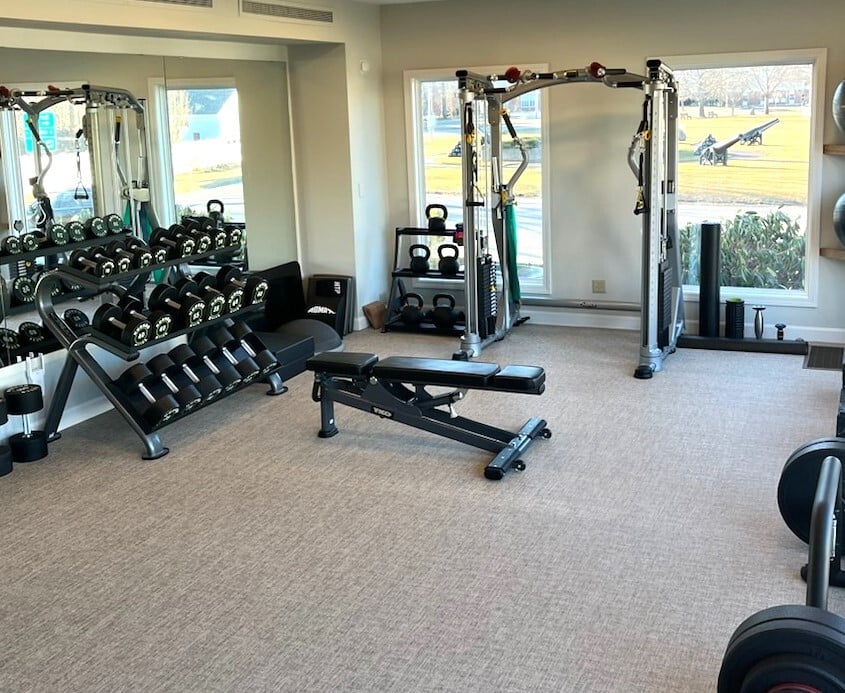
Where it fits best: finished basements, bonus rooms over a garage, gyms that share space with an office or media room, and any home gym an interior designer is involved in. Photos don't do it justice, so we suggest seeing the samples in person.
The workhorse: ECORE Rally
If the room is purely a gym, Rally is our default. It is 14.5mm stacked rubber with over three times the energy absorption of standard 8mm hard rubber (35.4% vs. 10.4% in ECORE's testing) that most people buy online. That means less force back into your knees and back, less vibration into the house, and no tire-factory smell. It comes as interlocking tiles that need no glue, or as rolls for larger rooms.
For rooms that want a premium look in a more traditional gym style, PaviGym is the other option we show. It is virgin rubber rather than recycled, with a wider range of colors and surfaces. ConnectFit is PaviGym's primary dealer in New England.
What about lifting and drop zones?
Rally handles a power rack and normal strength training on its own. If you deadlift heavy or drop weights, we inlay ECORE Impact Zones into the floor: a solid 14.5mm rubber drop area built for repeated impact. Because it is the same thickness as Rally, it sits flush with the rest of the floor, with no ramp or lip to trip on, and it is cut to fit on site.
Our installation team at Working Wolfe handle most of these drop-zone installs for us. For serious Olympic lifting, we build a dedicated platform with Shockpad underneath.
It depends on the room: Boston home gyms by type
Basement on concrete
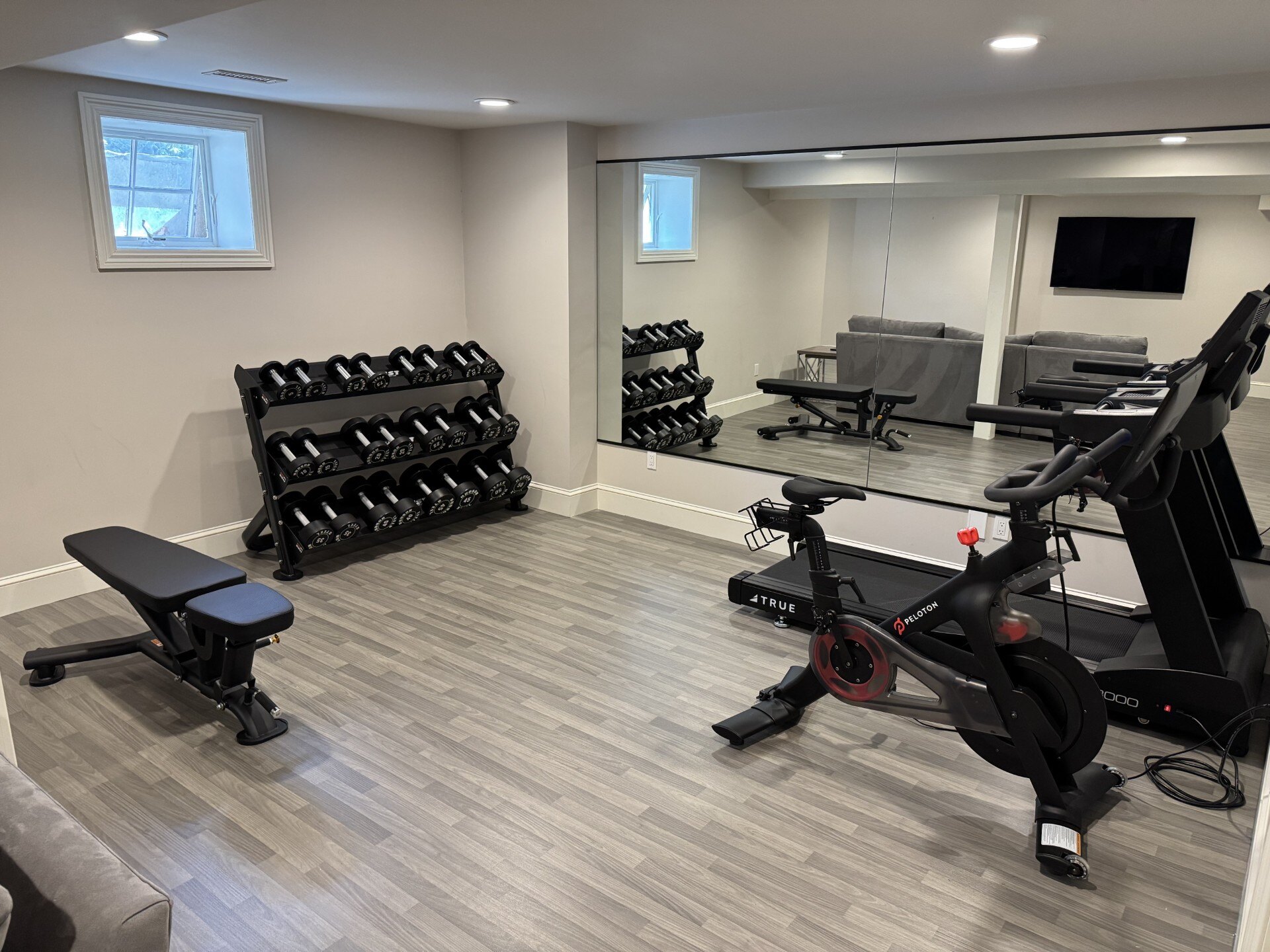
Concrete is the best subfloor there is: flat, firm and stable. The issue in New England basements is moisture. If the slab ever feels damp, put a vapor barrier down first. Rally tiles or Ebb & Flow both work well here, depending on whether the basement is a gym or a finished living space.
Garage gym
Boston garages go from below freezing to humid summer heat. Interlocking tiles (Rally or ECORE Ultratile) handle those temperature swings better than glued-down rolls, need no adhesive, and come up if you ever need the garage back.
Upstairs room or bonus room on a wood frame
Here the question is noise and vibration traveling into the rooms below. Add Shockpad underlayment under the finish floor. It is the most cost-effective noise upgrade you can make in a residential gym.
Condo or brownstone unit
Someone almost certainly lives below you, and many buildings have rules about it. Plan for Shockpad under a stacked floor from the start, keep heavy drops to a dedicated drop zone, and check your building's requirements before you buy anything.
A room that has to look good
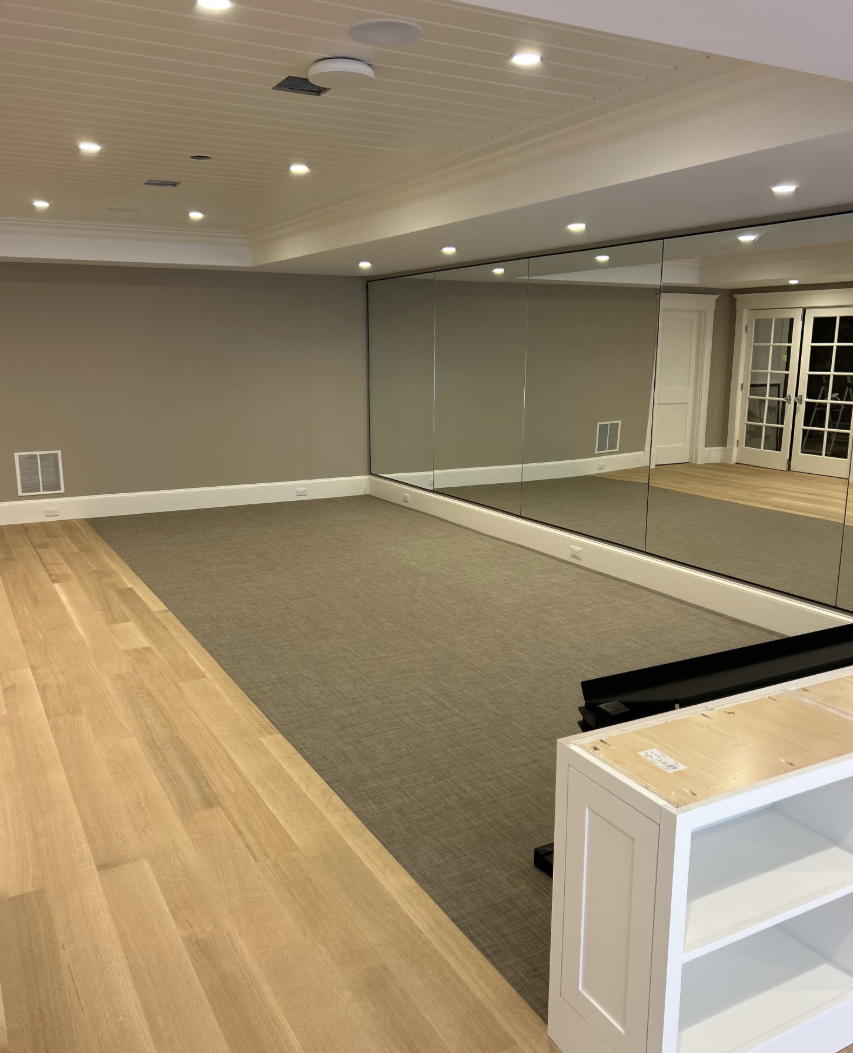
Go with Ebb & Flow, Bounce2, or PaviGym. This is where the floor makes the biggest difference to how the room feels.
The mistakes we see most
- Horse-stall mats. Cheap and tough, but hard on joints, heavy to move, and they often smell for months.
- Budget foam or online rubber tiles. They compress under equipment, leaving treadmills and racks out of level, and the recycled versions off-gas.
- Carpet under cardio equipment. Static, sweat, odor and wear.
- Ignoring the room below. Adding sound control after the fact costs more than planning for it.
- Too many seams. We custom-cut flooring to the room to keep seams to a minimum.
A real example
For a multi-generational family in Brookline, we used ECORE Rally under a full strength setup so the floor could handle everyone from the kids to the grandparents. You can read about the project in Fisher Hill Brookline Multi-Generational Home Gym.
Frequently asked questions
What is the best flooring for a home gym? For most home gyms, stacked rubber such as ECORE Rally. For a gym that is part of the living space, ECORE Ebb & Flow. Add Shockpad underneath if there is occupied space below.
Stacked rubber outperforms hard rubber every time.
Is rubber or vinyl better for a home gym? Both can work. Stacked rubber like Rally is the performance default. Ebb & Flow is a woven vinyl surface over an impact-absorbing base, so you get similar protection with a much more finished look.
How thick should home gym flooring be? Rally at 14.5mm covers cardio, dumbbells and a power rack. Heavy lifting areas get an inlaid Impact Zone at the same thickness, or a dedicated platform for Olympic lifting.
Can I put a home gym on carpet? We don't recommend it for cardio equipment, because of static, sweat absorption and wear. Ebb & Flow is the better choice when you want a soft, finished look. You *can* put Ultratile right on top of carpet, though.
Do you install home gym flooring? Yes. We measure, custom-cut and install across Greater Boston, MetroWest, the North and South Shore, and Cape Cod and the Islands.
See it before you decide
The best way to choose a home gym floor is to stand on it. Visit ConnectFit at 84 Needham Street in Newton, MA to see Ebb & Flow, Rally and PaviGym side by side, or reach out here to plan your room. For more detail on flooring for commercial facilities and weight rooms, see The Real Gym Flooring Guide.

COMMENTS