


ConnectFit | Buyer's Guide
What Makes a Good Olympic Bar?
Everything we evaluate before recommending a bar, from $150 to $1,350.
We sell Olympic bars at ConnectFit from $150 to $1,350. That is a quite a wide range, and clients ask about it all the time. The honest answer is that an Olympic bar looks simple and is really not. The difference between a $150 bar and a $1,290 bar lives in the steel alloy, the tolerances machined into every sleeve and collar, the quality of the rotation system, and the physics of what actually happens when serious weight goes on a bar. How much do people need? That's based on use and need. But I have gyms and studios I work with who swear by their better bars.
A lot of this knowledge comes from conversations over the years with my good friend Ivan at Ivanko Barbell, one of the most deeply knowledgeable people in the industry on the subject of bar metallurgy and failure. When you are investing in a bar meant to last decades, that kind of engineering perspective matters, even though he may talk your ear off.
In a good way.
First: Which Type of Bar?
Before you talk about quality, you have to talk about application. There are two fundamentally different bars, and confusing them is a common and expensive mistake.
The Olympic Weightlifting Bar
This is a 28mm shaft designed for the snatch and the clean and jerk. Its defining characteristics are high whip, meaning intentional flex in the shaft under dynamic load, and maximum spin via bearings. The whip matters because the bar's elasticity is part of the biomechanics of those lifts. The spin matters because the wrists and elbows need to rotate freely during the pull. Women's bars are 25mm and 15kg; men's are 28mm and 20kg. This is based on competition number, nothing else.
The Powerlifting Bar
This is a 29mm shaft built for the squat, the bench press, and the deadlift. Whip is actually much the enemy here. You want a stiff bar that does not flex under a maximal squat, and you want controlled spin rather than maximum spin, so bronze bushings rather than needle bearings are often the right call. It is not inferior to the Olympic bar at all, It is designed to perform a specific task.
|
So that you know, for 90% of home gym owners and most boutique training spaces, a well-made hybrid bar in the mid-range is the most practical choice. The hybrid configuration handles both movement patterns at a level of performance that even serious recreational lifters might never outgrow. And so most moderate bars are specifically built to be a bit in between the two, and with markings for both. |
Tensile Strength: The Only Number That Really Matters
There is a lot of marketing noise around bar strength. Manufacturers love phrases like "1,000-pound test" because they sound definitive and mean almost nothing. The physics of bar bending are more complicated than a single load number, and any claim stated that simply is, as my friend Ivan has put it, closer to fantasy than engineering. I've had thousand pound test bars brought back to me bent after 300 lb squats.
The two designations that actually matter are tensile strength, which measures how much pulling force the steel can resist before deforming permanently, and yield strength, which measures the point at which deformation becomes irreparable rather than permeable. Both are stated in pounds per square inch (PSI). You cannot see these numbers by looking at the bar. You have to be able to trust the manufacturer's stated figures and, more importantly, the manufacturer's reputation for backing them up.
Here is a practical benchmark:
|
Tier |
Tensile strength |
What it means |
|
Entry-level |
130,000-155,000 PSI |
Fine for light home use, moderate loads |
|
Mid-range |
170,000-190,000 PSI |
Serious home gyms and boutique studios |
|
Elite / competition |
190,000-218,000+ PSI |
Commercial, competition, lifetime ownership |
170,000 PSI is the numerological floor below which we start to have concerns about long-term performance under serious and regular training loads. Above 190,000 PSI, you are in the territory of bars that are mag tested, ultrasonic tested, and straightness certified, which is to say bars where the manufacturer's quality process is actually documented and verifiable rather than simply claimed.
And man, the things people claim....
How Bars Actually Bend
This is one of the most misunderstood things in the equipment business, and understanding this protects both the bar and my clients. Nearly every bent bar we have ever seen bent the same way, and it has a lot less to do with how much weight was on it than anyone thinks.
When the plates hit the floor before the bar does, the force distributes across the plate surface and the bar survives even heavy drops reliably. When the bar hits a power rack pin, a narrow bench edge, or any hard surface before the plates do, the force concentrates at a tiny contact point. A 400-pound bar dropped three feet onto a rack pin can exert effective force many times its static weight at that contact point. That is often how bars bend in the field, regardless of the quality of the steel, and it is why setup and usage matter as much as specifications
|
Any bar, at any price point and quality, will bend if the geometry is wrong. Lift smart. |
The Rotation System
The sleeve spin is what allows the plates to decelerate independently from the bar during dynamic lifts. Without apposite spin, the rotational forces move directly into the wrists and elbows of the lifter, which is exactly the opposite of the goal during a snatch or clean.
Needle bearings
The smoothest spin available. Multiple and successive bearing surfaces allow the sleeve to rotate almost frictionlessly, which is why competition Olympic lifting bars universally use them. They require periodic lubrication and some maintenance attention, but in a well-run training environment that is normally not an issue. For homes...I can't tell you often I feel rough and unlubed bars.
Bronze bushings
Very good spin with considerably more durability and MUCH less maintenance required than bearings. The right call for powerlifting bars and for commercial environments where volume is high, or when maintenance schedules are unpredictable. Or both.
Composite bushings
Fine, fine....somewhat adequate for light use and infrequent training. Under real training volume, spin quality and longevity decline quickly. Most budget bars use composite bushings, and this is usually where performance starts to degrade from the stated specifications with regular use.
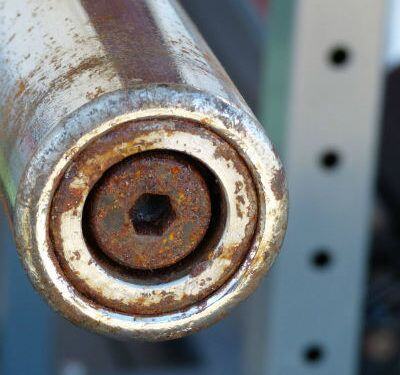
Finish and Corrosion Resistance
The finish determines how the bar ages, particularly in humid environments. In New England, where humidity swings are significant and most fitness rooms are not climate-controlled to museum standards, finish quality is not cosmetic. And let's not talk about the Cape and Islands. Take a garage gym, put it on the Cape and you can image how fast we have issues.
|
# |
Finish |
Rust resistance |
Notes |
Best for |
|
1 |
Stainless steel |
Best |
No coating. Should not rust, pit, or peel. |
Lifetime ownership and serious users |
|
2 |
Cerakote |
Excellent |
Thin ceramic coat. Durable, tactile, available in colors. |
Boutique / commercial |
|
3 |
Hard chrome |
Good |
Slick and sharp. Can pit if moisture penetrates long-term. |
Climate-controlled spaces |
|
4 |
Bright zinc |
Fair |
Degrades in humid environments within 18-24 months of heavy use. |
Budget / dry conditions. |
|
5 |
Black oxide / bare |
Needs care |
Raw feel, excellent chalk adhesion. Requires light oiling. |
Dedicated lifters only, as it needs to be oiled. |
Knurling: The Goldilocks/Porridge Problem
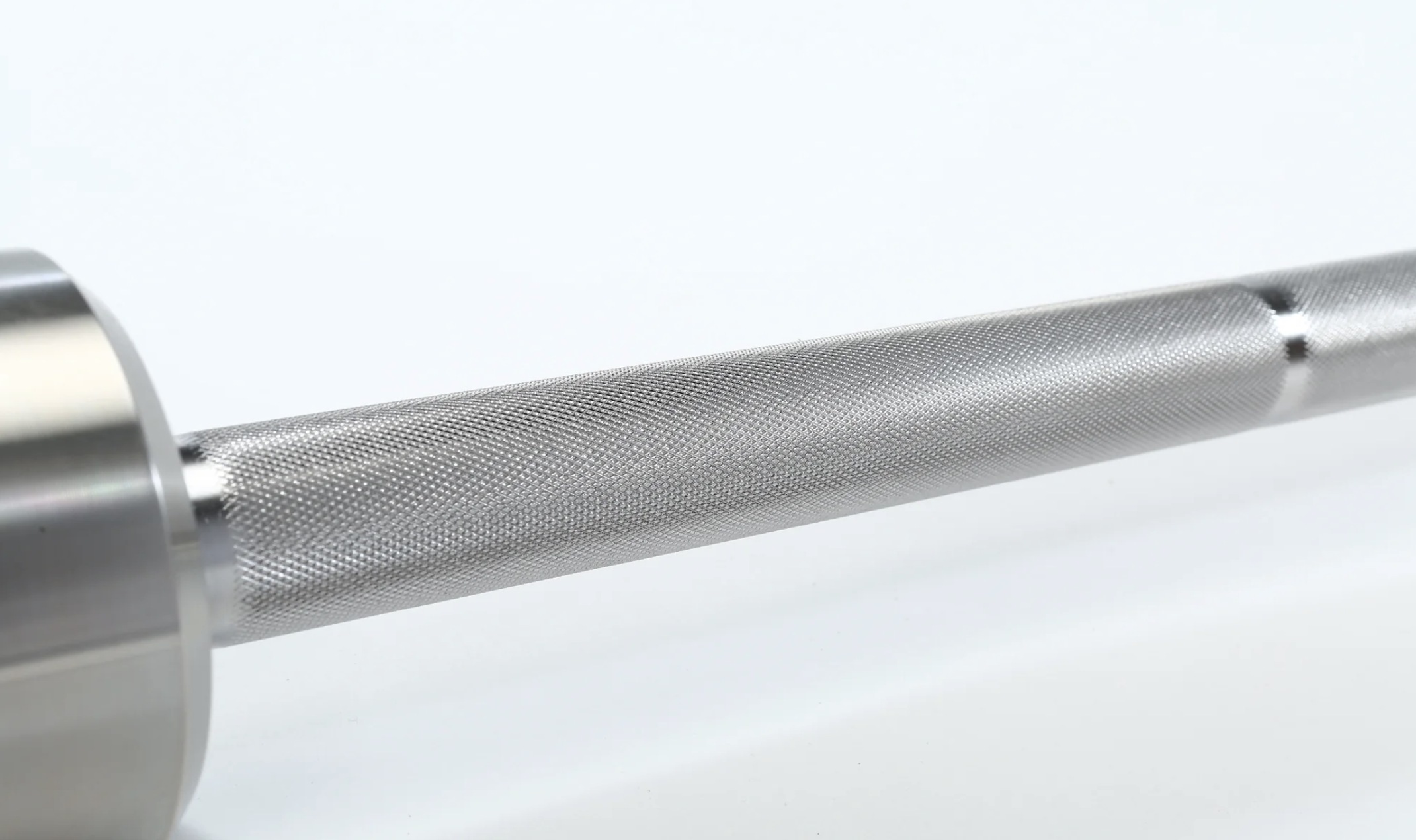
Knurling is the diamond-pattern grip texture machined into the shaft of a bar. It seems like a minor detail and it is not, especially for serious use. Too passive and the bar can slip or move under a maximal deadlift or a heavy clean. Too abrasive and high-rep work tears the hands up in a way that accumulates across training weeks and becomes a real problem. The right knurling is firm enough to give total confidence under load and fine enough to be livable across volume of a user. Competition-grade bars, such as the Ivanko, machine their knurling to IWF specification, which is a tested and verified standard rather than a marketing description. Yes, the IWF has a knurling spec. Budget bars often have inconsistent knurling across bars or even over individual units, which is one of the signs that quality control might be loose throughout the manufacturing process.
A Warranty Is Only As Good As the Company Behind It
This is one of the most important things we tell clients and one of the least obvious at the point of purchase.
Reputable dealers carry brands that actually stand behind their products, because we are accountable to our clients long after the sale is made. That relationship matters when something goes wrong two years in. We know the manufacturer, we have an established commercial relationship, and we can make things right. That is simply not true of most online purchasing experiences. These are the bars and brands you see in real gyms.
Here is the harder truth: roughly 90% of the bars sold online today, including many with different names, different logos, premium-sounding descriptions, and confident lifetime guarantees, come out of the same four or five factories in China. The branding changes, but the bar is the same. A warranty from a company with no physical presence, no established dealer network, and no long-term stake in your satisfaction is a marketing scam. The industry has seen this pattern play out repeatedly.
|
When you buy from a specialist dealer, you are buying accountability. ConnectFit carries many different brands, including TKO, Hudson Steel, Hampton and Ivanko, and are backed by manufacturers who have been in this industry for decades and whose reputations depend on standing behind what they sell. |
Example of the ConnectFit Lineup: Three Bars at Three Levels
Here is how the range breaks down in practice, with a real example at each tier.
Entry: $150-$299
Good bars for home gyms that see moderate loads and reasonable volume. Tensile strength in the 130,000-155,000 PSI range, brass or composite bushings, chrome or black oxide finish. These bars perform well when used as intended and should not be dismissed. However, they are not suitable for commercial use or for lifters pushing serious numbers.
|
CF Example TKO 7' Olympic Bar 152,000 PSI | Oil-impregnated brass bushing | Hard chrome finish | Medium knurl | 30mm shaft | Factory-tested for strength and straightness on every unit $250 |
Mid-Range: $300-$699
This is where the most serious home gym buyers and boutique studio operators work, and for good reason. Tensile strength jumps into the 170,000-190,000 PSI range, rotation systems move to bronze bushings or entry-level bearings, and finishes step up to triple chrome or Cerakote. These are bars are meant for real training volume and real longevity.
|
CF Example Hudson Steel Brooklyn Bar Triple-coated chrome finish | Hybrid hash marks at 32" and 36" | Precision-engineered to tight tolerances | Built to handle serious training volume over the long term $629 |
Elite: $700-$1,350
This is competition grade, made to live in a powerlifting gym or a serious user. The steel is certified, the testing is documented, and the bar is built to perform the same way on day one and year ten. If you are outfitting a commercial facility, running a serious athletic training program, or simply buying the last bar you ever intend to buy, this is the tier.
|
CF Example Ivanko 28mm Stainless Steel Olympic Bar 218,000 PSI | Mag tested | Ultrasonic tested | Straightness certified | 28mm shaft / 20kg / 7'2" | IWF knurling specification | AAU approved | Made in USA | German precision bearings $1,290 |
ConnectFit | Fitness room design & installation | connectfit.com


COMMENTS