


USA Manufactured Bars, at ConnectFit
ConnectFit is now sourcing Olympic bars direct from Solid Bar Fitness in Waterville, Kansas. Here is why that matters.
Walk into a hundred weight rooms and you will find a hundred logos on the hundred bars. Walk into the factories that made them and the number drops fast.
That is not a scandal that we are reporting on. Not like all those fake review sites!
It is how the barbell business has always worked. Bars are a machining product. You need CNC capacity, a steel supply, knurling tooling, sleeve fixturing, and decades of knowing why a spec that looks fine on paper snaps on a fourth rep. Very few companies own that. Most companies own a logo, a catalog page, and have someone else make their bars.
So the question a serious buyer should be asking is not which brand of bar. It is whose machines.
For a large share of the American-made bars in this market, the answer is Solid Bar Fitness, in a town of about 650 people in Marshall County, Kansas.
Who Actually Manufactures These American-Made Olympic Barbells?
Brad and Lynn Roepke have been building Olympic bars in Waterville, Kansas for over three decades. Brad started making equipment in his garage. Lynn ran a gym in a basement. That origin story is not marketing copy pasted over an import container, which is the more common version of it in this industry.
The relevant facts about Solid Bar Fitness:
- Fourteen bars in the line, all stress-proof high-strength alloy steel. Everyone.
- 100 percent manufactured and assembled in Kansas, with American steel. No overseas shafts, no overseas sleeves, no overseas hardware. That is a harder claim to make than most brands admit, and most of them do not make it.
- Lifetime warranty against manufacturer defects.
- Solid Bar holds the patent on its detachable collar design.
- Solid Bar manufactures the Marrs-Bar, the shoulder-lift bar with the curved pad that other manufacturers turned down as a machining nightmare.
- Solid Bar won a U.S. Army contract for 27,000 combat fitness bars. Twenty-seven thousand. A procurement office that audits its supply chain picked a shop in Waterville.
- And Solid Bar private labels. Their own site says it plainly: brand your name with us. Solid Bar has been building bars that ship under other companies' logos for years, so often, you are paying an extra markup.
That last line is the entire point of this post.
What Does a Private-Label Barbell Actually Cost You?
Here is the structure of the transaction most facilities are unknowingly in.
Solid Bar machines the bar. A brand buys it, puts its own logo and finish package on it, marks it up, and sells it online as their own. We're going to the source.
Buying a private-label bar also means inheriting three problems that have nothing to do with the steel:
Warranty distance. Your lifetime warranty is now administered by a brand that did not make the bar, sold online to you on some website, not even a store to go back . Every claim is a relay race. We have watched this play out on other categories for years. Warranties are sticky, and the further you sit from the factory, the stickier they get in the wrong direction.
Spec drift. When you buy a labeled bar, you buy whatever the labeling company ordered that year, or whatever they put on their site. Change the finish, change the knurl depth, change the bushing, and the label stays identical. Two bars with the same logo, bought four years apart, can be genuinely different bars. Buying at the source means you are buying a part number, not a marketing name.
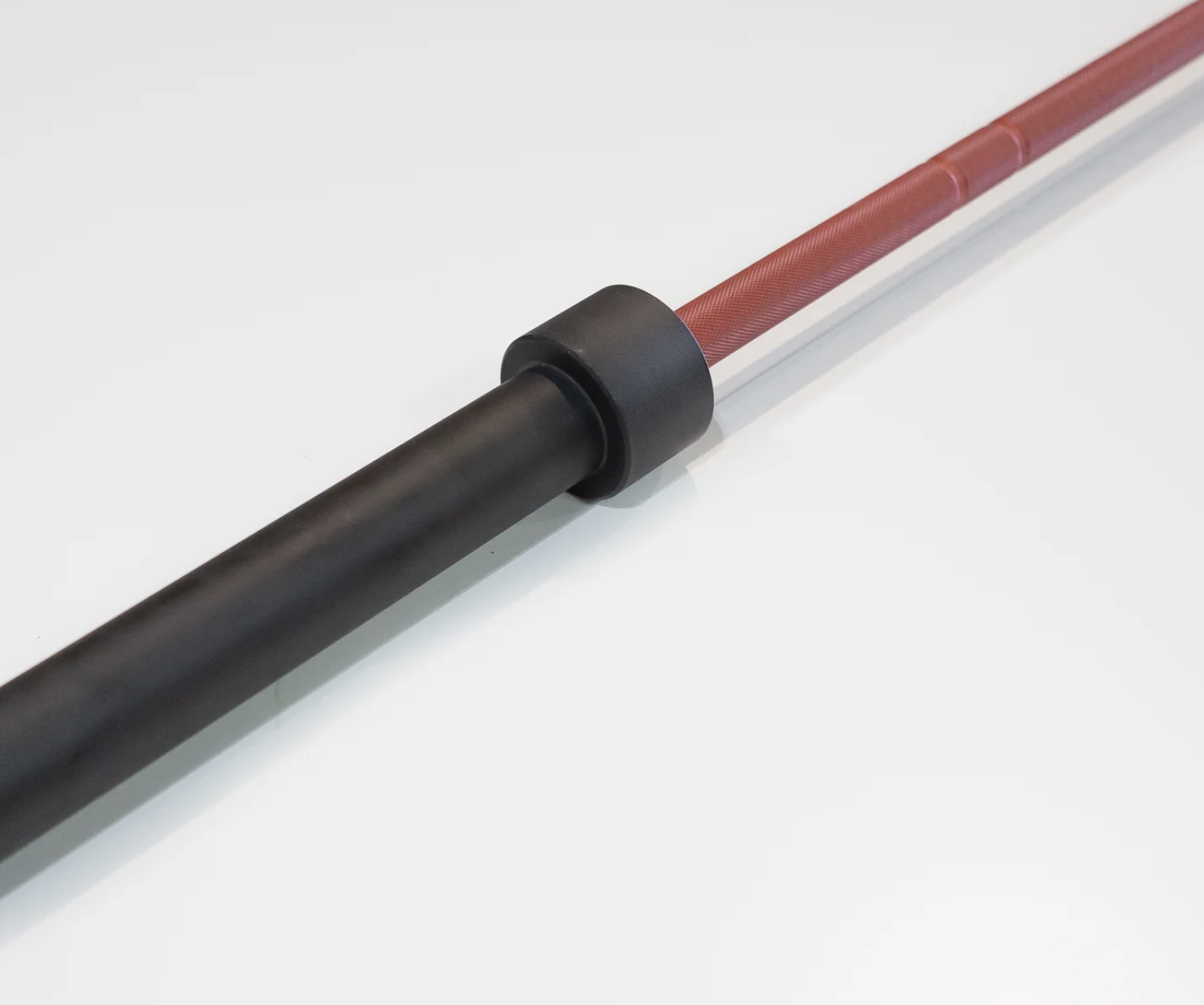
Which Barbell Finish Is Best for a School or Commercial Weight Room?
Skip the tensile numbers for a minute. In institutional and multi-tenant rooms, the bar almost never fails structurally. A bar fails cosmetically first, then it fails at the knurl, and then it becomes a liability item that somebody has to justify removing.
We have documented this in detail. In school weight rooms ConnectFit surveyed this year, rusted Olympic bars and dumbbells were on the priority removal list at every single site. Knurling rust is the dangerous kind, because the knurl is the contact surface. A rusted bar is not an aesthetics problem. It is a grip failure waiting for a heavy pull, and rust and bacteria can get into a wound.
Barbell finish is the single biggest lever on that outcome, and the finish decision should be driven by the room, not by the catalog.
| Finish | Feel at the hand | Corrosion resistance | Where it belongs |
|---|---|---|---|
| Bare / polished steel | Best raw steel feel | Lowest. Needs oiling. | Dedicated platforms with real maintenance discipline. Almost never a school. |
| Black oxide | Excellent. Direct steel feel, sharp knurl. | Low to moderate. Will patina and eventually rust if neglected. | Supervised strength programs, collegiate, controlled climate. |
| Bright zinc | Slightly slicker than oxide | Good | Sleeves on nearly everything. Shafts in general-population rooms. |
| Hard chrome | Slick, blunts knurl feel | Very good | High-traffic mixed-use commercial floors. |
| Cerakote | Retains knurl definition better than chrome | Best in class. Polymer-ceramic. | Coastal facilities, humid rooms, poolside fitness, schools with no maintenance budget, anything where nobody is going to oil a bar. Ever. |
The Cerakote row in this graph is not a small note. A Cerakote bar carries a real premium over black oxide. A Cerakote bar also does not end up in a photograph of a priority removal list in eight years. Run that math on a room with twelve bars and the premium stops being a premium and starts being a maintenance program you already paid for.
Solid Bar builds across that entire finish range, including Cerakote, in Kansas. So the finish conversation becomes an actual engineering conversation instead of a "which of these three SKUs did my dealer stock" conversation.
Which Olympic Bar Should You Buy for Your Type of Gym?
Most facilities buy one bar and pretend it covers everything. One bar does not cover everything.
- General-purpose room, mixed population. Standard Olympic bar, bushing rotation, moderate knurl. Do not buy an aggressive powerlifting knurl for a room full of fifteen-year-olds and lunchtime members. Aggressive knurl tears hands and it looks like negligence.
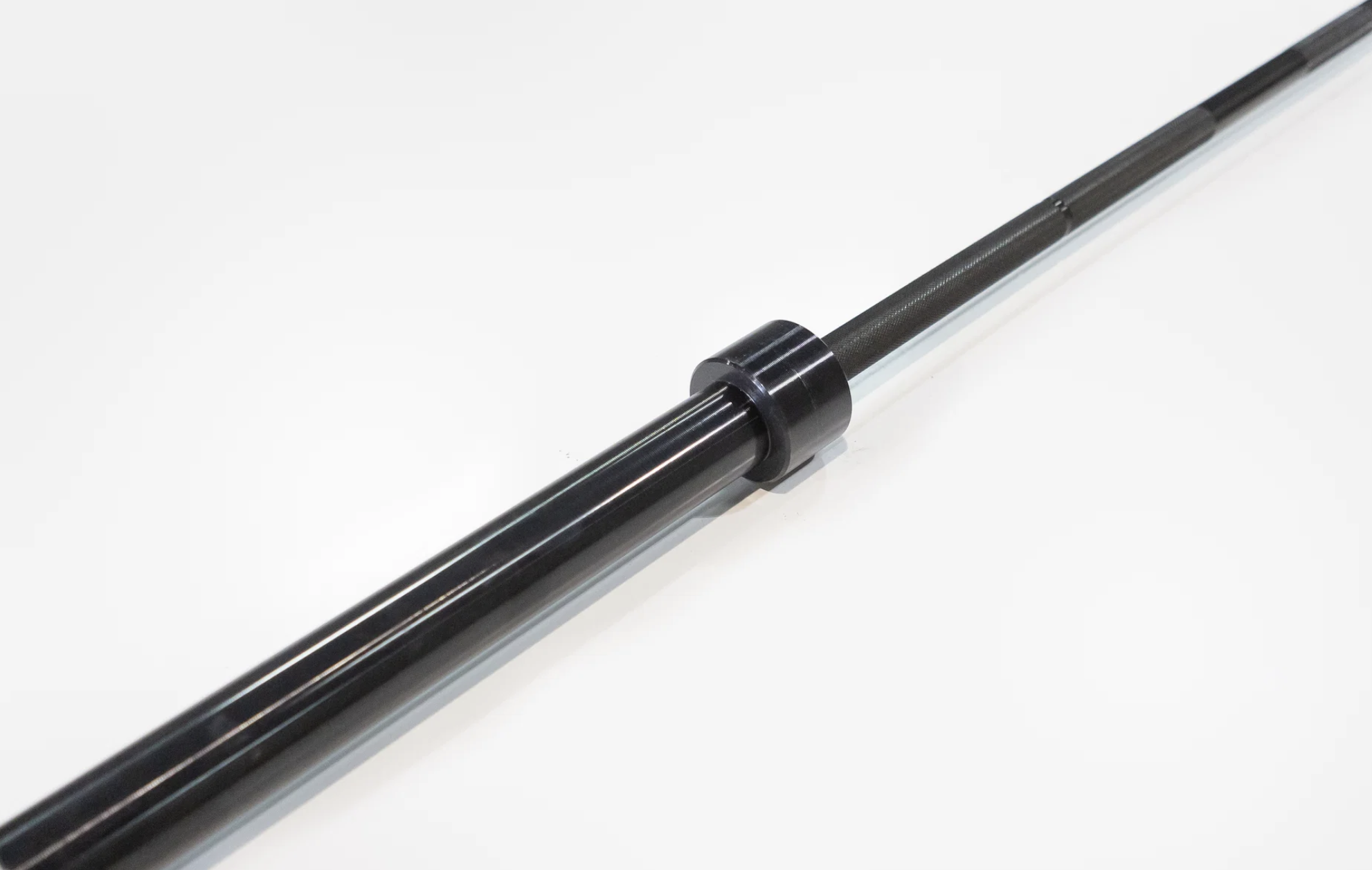
- Powerlifting and serious strength programs. Kansas Power Bar. 28.5 mm shaft, 200,000 psi, deep knurl with a center knurl, IPF specification. Stiff, with just enough whip on a heavy pull. The center knurl is exactly why this bar does not belong in the general-population room.
- Olympic lifting instruction. Needle bearing bar. Spin matters when the lift depends on the bar rotating under the wrist.
- Teaching and entry. The 15 lb aluminum technique bar. The light technique bar is the single most underspecified item in American weight rooms. A room without one teaches bad bar paths to everyone who walks in it.
- Deadlift and shrug work, and any room where you want safer loaded carries. Hex and trap bars. Solid Bar builds these too, which matters because trap bars are the item most often bought as an afterthought from whoever is cheapest, and trap bars are also the item most often found rusted through on a facility survey.
- Shoulder-friendly squat loading. The Marrs-Bar. For populations with shoulder mobility limitations, rotator cuff history, or a coach who is tired of watching kids try to rack a bar they cannot get their hands behind. Nobody else makes it.
A room specified this way costs slightly more up front and eliminates roughly half the arguments that happen in year three.
Why Is ConnectFit Buying Direct From the Manufacturer?
First, because we know them. Decades of experience in picking brands and partners means we know the players.
And ConnectFit has said a version of this before about other categories. The value in this industry hides at the point of manufacture. It hid in patent portfolios when we wrote about who actually owns the elliptical drive technology. It hides in factory relationships here.
Our position has always been that a consultant who cannot tell you where a product is actually made is not much of a consultant.
Going direct to Solid Bar gives our clients four things:
- Factory pricing without the two intermediate margins that exist purely to pay for a logo.
- A direct warranty line to the people who cut the steel.
- Custom capability. Custom finishes, custom knurl, custom specification. Solid Bar will build to the room. If a school or a club wants its own name on the bar, that is the facility's name on the facility's equipment, and Kansas will do it. What will never appear on it is ours.
- Domestic supply chain certainty. All American steel, all American components, assembled in Kansas, with exacting specs. In a tariff environment, that is not merely a patriotism argument. It is a lead time and pricing stability argument. Ask anyone who specified imported bars in the last eighteen months how their delivery dates held up.
Why Doesn't ConnectFit Sell Its Own Brand of Equipment?
Solid Bar will private label. Private labeling is a legitimate business and it is a large part of theirs. Plenty of the bars in this market carry a logo that Waterville put on at somebody's request, and there is nothing dishonest about it on the manufacturing side.
ConnectFit will not be one of those somebodies.
The moment a consultant puts his own name on a product, he stops being a consultant. He is now carrying inventory he has to move. Every recommendation he makes after that is contaminated, and the client can never again be sure whether he was told the truth or told the thing with the better margin on it. That is not a hypothetical failure mode. It is the entire reason this industry is full of people who will tell you their house brand is the best value in every category, in every room, at every price point, for every client, forever. I've watched it play out dozens of times.
You cannot advise on a category you compete in. So ConnectFit refuses to private label.
Look at how the rest of this industry is actually built.
The manufacturer who owns the store. Johnson Health Tech builds Matrix, Vision, Horizon, and now BowFlex and Schwinn, out of overseas plants. Johnson also owns Johnson Fitness and Wellness, north of 460 retail locations. So the company that made the treadmill also owns the showroom where a salesperson explains to you why that treadmill is the right treadmill. There is no version of that conversation where a competing product wins on merit, because there is no mechanism by which it could.
The retailer who built a brand. More common, and less visible to the buyer. A dealer with enough volume goes to the same overseas factories the brands use, orders in container quantity, puts his own name on it, and sells it through his own floor. Now that dealer collects the manufacturer's margin and the retailer's margin on a single transaction. Depending on the operation, that stacked position can account for a very large share of the company's actual profit, which means the house line is not a sideline. It is the business. Everything else on the floor is there to make the room look like a choice.
Neither of those is fraud. Both are ordinary and legal and, from a margin standpoint, obviously correct. That is exactly the problem. The incentive is structural, not personal. Good people inside those structures still produce compromised recommendations, because nobody in the building is paid to say "buy the other one."
ConnectFit is not built that way, and is not going to be.
ConnectFit does not manufacture. ConnectFit does not private label. ConnectFit does not own a brand and will not own one. What we own is knowing where things are actually made, which brands are still real companies, whose warranty is worth the paper, and which of the fourteen bars in Waterville belongs in your specific room.
Which is why we can carry a brand and still tell you when it is the wrong call. We specify Hoist selectorized equipment constantly, because for institutional rooms with mixed populations the biomechanics justify it. I carry both Landice and True as top treadmill brands. We are specifying Solid Bar for the bars, because for that category Kansas is the right answer. Those are different companies. If either stops being the right answer next year, we will say so and nothing on our balance sheet will object.
That is the whole business. ConnectFit is responsible to one thing, and it is not a product line. We are and have always been about the client experience, because that is what brings people back.
We make a little less money. We remain trusted. That trade has never once been close.
What Should You Ask Before Buying Olympic Bars?
If you take nothing else from this, take these four questions. Ask them of whoever is quoting your next bar package.
- Who manufactures this bar, and where? Not "where is the brand headquartered." Where is the machine.
- Is the steel domestic, and are the components domestic? Those are two different questions and a lot of "assembled in USA" answers fall apart on the second one.
- Who administers the warranty, and how many phone calls is a claim?
- Do you sell your own brand? If the person specifying your room also owns a label in that room, you are not getting advice. You are getting a sales call.
If the answers are vague, you have your answer.
Frequently Asked Questions
Who makes Solid Bar Fitness barbells, and where are they made? Solid Bar Fitness is an independent manufacturer in Waterville, Kansas, owned and operated by Brad and Lynn Roepke for more than three decades. Solid Bar barbells are machined and assembled at the company's own facility in Kansas rather than sourced from an overseas contract manufacturer.
Are Solid Bar Fitness barbells actually made in the USA? Yes. Solid Bar Fitness states that its bars are 100 percent manufactured and assembled in Kansas using American steel, with no steel or components brought in from overseas. That is a stricter claim than "assembled in USA," which often means domestic assembly of imported components.
Does Solid Bar Fitness private label barbells for other companies? Yes. Solid Bar Fitness manufactures weightlifting products that ship under other companies' brand names, and openly offers private labeling to dealers and brands. This means a number of Olympic bars sold in the United States under other logos are Solid Bar products with an additional layer of markup.
What is the best barbell finish for a school weight room? Cerakote offers the best corrosion resistance of the common barbell finishes and is the strongest choice for schools, coastal or humid facilities, and any room without a consistent equipment maintenance program. Black oxide gives the best raw steel feel and sharpest knurl but requires regular oiling and will corrode if neglected. Hard chrome and bright zinc sit between the two.
Why do Olympic bars in school weight rooms rust, and why does it matter? Uncoated and lightly coated bars corrode when they are not oiled regularly, which is the normal condition in most school facilities. Rust on the knurling is the serious form, because the knurl is the primary hand contact surface. A corroded knurl is a grip failure risk during heavy pulls, which makes rusted bars a liability item rather than a cosmetic one.
What is a Marrs-Bar and who manufactures it? The Marrs-Bar is a shoulder-lift squat bar with a curved padded yoke, designed by Zac Marrs and manufactured by Solid Bar Fitness in Kansas. It allows loaded squatting without requiring the lifter to reach back and grip a straight bar, which makes it useful for athletes with shoulder mobility limitations or rotator cuff history.
Does ConnectFit sell its own brand of fitness equipment? No. ConnectFit does not manufacture, does not private label, and does not own an equipment brand. The company specifies and supplies equipment from independent manufacturers, which allows it to recommend against any product in any category without a financial conflict.
ConnectFit specifies and supplies commercial fitness environments for builders, designers, schools, municipalities, and institutional clients throughout New England. We carry no house brand and never will. Newton, Massachusetts. If you have a bar package, a full weight room, or a rust problem you have been putting off, get in touch.


COMMENTS